



DOSING
Same Starting Dose of VEPPANU for All Patients—One 200-mg Tablet Daily1

VEPPANU should be taken with food at approximately the same time each day

How patients should take VEPPANU
Patients should swallow VEPPANU tablets whole
Tablets should not be chewed, crushed, dissolved, or split prior to swallowing
Tablets should not be chewed, crushed, dissolved, or split prior to swallowing
Patients should not take VEPPANU tablets that are broken, cracked, or look damaged
Patients should not take VEPPANU tablets that are broken, cracked, or look damaged

What patients should do in the event the proper dose is not taken
Patients who miss a dose or vomit after taking a dose on a treatment day should take the next dose the following day at the regularly scheduled time.
Prior to initiation of VEPPANU:
Confirm presence of ESR1m
Correct electrolyte abnormalities
Perform an ECG; do not initiate if QTc >470 ms and avoid concomitant drug known to prolong QTc interval*
Repeat ECG approximately 4 weeks after initiating treatment and as clinically indicated
*For dosage modification and management for QTc prolongation or concomitant use of strong CYP3A inhibitors or inducers, see full Prescribing Information for VEPPANU.
VEPPANU is available in 2 dose strengths1
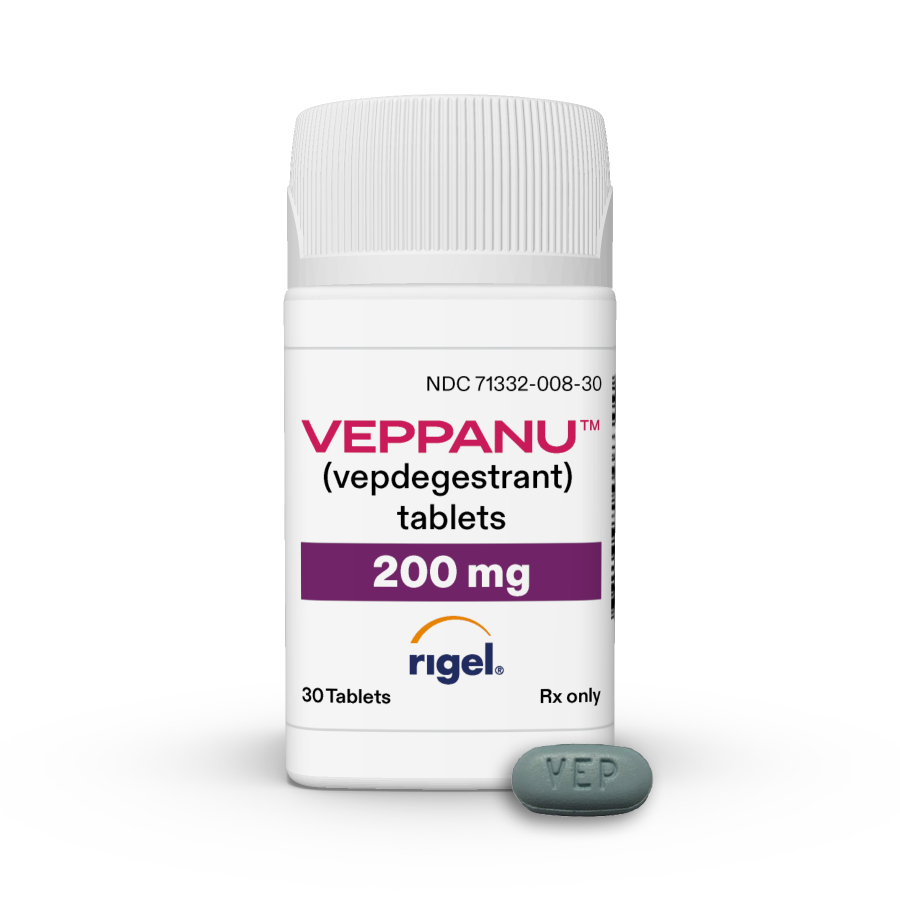
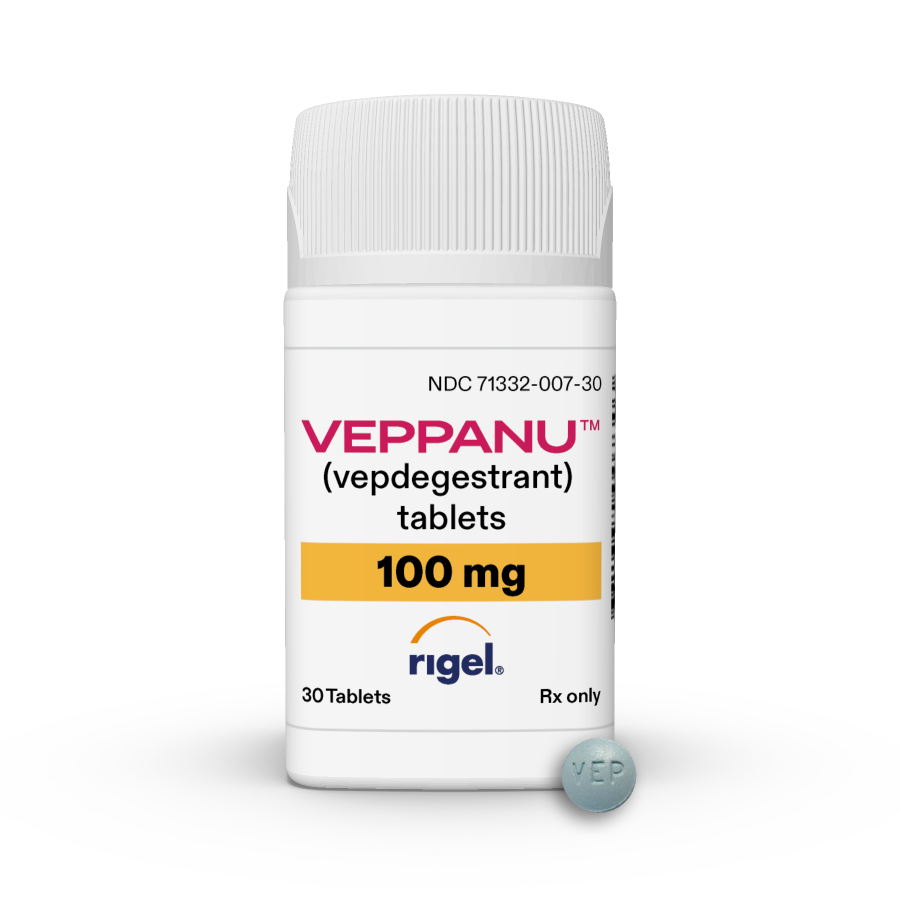
Recommended dose:
200-mg tablets
blue oval tablets, “VEP” debossed on one side and “200” on the other side
Dose for modifications:
100-mg tablets
blue round tablets, “VEP” debossed on one side and “100” on the other side
Recommended Dosage Modifications for Adverse Reactions1
CTCAE Severity Grade
Dosage Modification
Grade 1
No dose modification is required.
Grade 2
Consider interruption until recovery to grade ≤1 or baseline. Then resume at the same dose.
Consider interruption until recovery to grade ≤1 or baseline.
Then resume at the same dose level.
Grade 3
If the grade 3 toxicity recurs, interrupt VEPPANU until recovery to grade ≤1 or baseline. Then resume at the reduced dose (100 mg) or discontinue at the discretion of the physician.
Grade 4
First occurrence: Interrupt VEPPANU until recovery to grade ≤1 or baseline. Then resume at the reduced dose (100 mg).
If a grade 4 or intolerable adverse reaction recurs, permanently discontinue VEPPANU.
No patients discontinued treatment due to QTc prolongation1


Dosing Modifications in the Event of QTc Interval Prolongation

QTc interval prolongation was reported in 10% of patients during the VERITAC-2 study.
Grade 3 occurred in 1.6% of patients
Dose reduction was required for 0.3% of patients due to QTc interval prolongation
RECOMMENDATIONS FOR DOSE MODIFICATIONS IN THE EVENT OF QTc INTERVAL PROLONGATION
QTc Prolongation†
Dosage Modification and Management
QTc >480 ms or >60 ms increase from baseline (and QTc ≤500 ms)
Withhold until QTc resolves to ≤480 ms and ≤60 ms above baseline, then resume VEPPANU at the same dose.
Identify and treat reversible causes (eg, hypokalemia and hypomagnesemia).
Initiate more frequent ECG monitoring.
QTc >500 ms
Withhold until QTc resolves to ≤480 ms and ≤60 ms above baseline, then:
resume VEPPANU at the same dose if reversible cause is identified and corrected (eg, hypokalemia and hypomagnesemia)
resume VEPPANU at the reduced dose if no reversible cause is identified
Initiate more frequent ECG monitoring.
Permanently discontinue if QTc >500 ms recurs.
Torsade de Pointes, polymorphic ventricular tachycardia, or signs/symptoms of serious arrhythmia
Permanently discontinue VEPPANU.
†Heart-rate corrected QTc using Fridericia’s method.
Drug Interactions1
Prevention or Management
Strong CYP3A Inhibitors
Avoid concomitant use of VEPPANU with strong CYP3A inhibitors in patients receiving VEPPANU 200 mg once daily. If concomitant use cannot be avoided, reduce VEPPANU dosage
Avoid concomitant use with strong CYP3A inhibitors in patients receiving VEPPANU 100 mg once daily
Strong CYP3A Inducers
Avoid concomitant use with strong CYP3A inducers in patients receiving VEPPANU 200 mg once daily. If concomitant use cannot be avoided, increase VEPPANU dosage
Avoid concomitant use with strong CYP3A inducers in patients receiving VEPPANU 100 mg once daily
Mechanism and Clinical Effect(s)
Strong CYP3A Inhibitors
VEPPANU is a CYP3A substrate
Concomitant use with a strong CYP3A inhibitor may increase VEPPANU plasma concentration, which may increase the risk of adverse reactions associated with VEPPANU
Strong CYP3A Inducers
VEPPANU is a CYP3A substrate
Concomitant use with a strong CYP3A inducer may decrease VEPPANU plasma concentration, which may reduce the effectiveness of VEPPANU
ESR1m=estrogen receptor 1 mutation; QT=QT interval; QTc=corrected QT interval.


REFERENCE
1. VEPPANU [package insert] South San Francisco, CA: Rigel Pharmaceuticals, Inc.
VEP_BC-26093 1026