


Neil Santos Site

In patients with ESR1m, ER+/HER2– mBC after CDK4/6i and ≥1 prior ET

VEPPANU Demonstrated Superior mPFS and Favorable Efficacy Across Endpoints

Superior Efficacy vs Fulvestrant: mPFS More Than Doubled With VEPPANU1,2

In an open-label, randomized, phase 3 trial of patients with ESR1m, ER+/HER2− mBC (N=270)

PRIMARY ENDPOINT: PROGRESSION-FREE SURVIVAL*
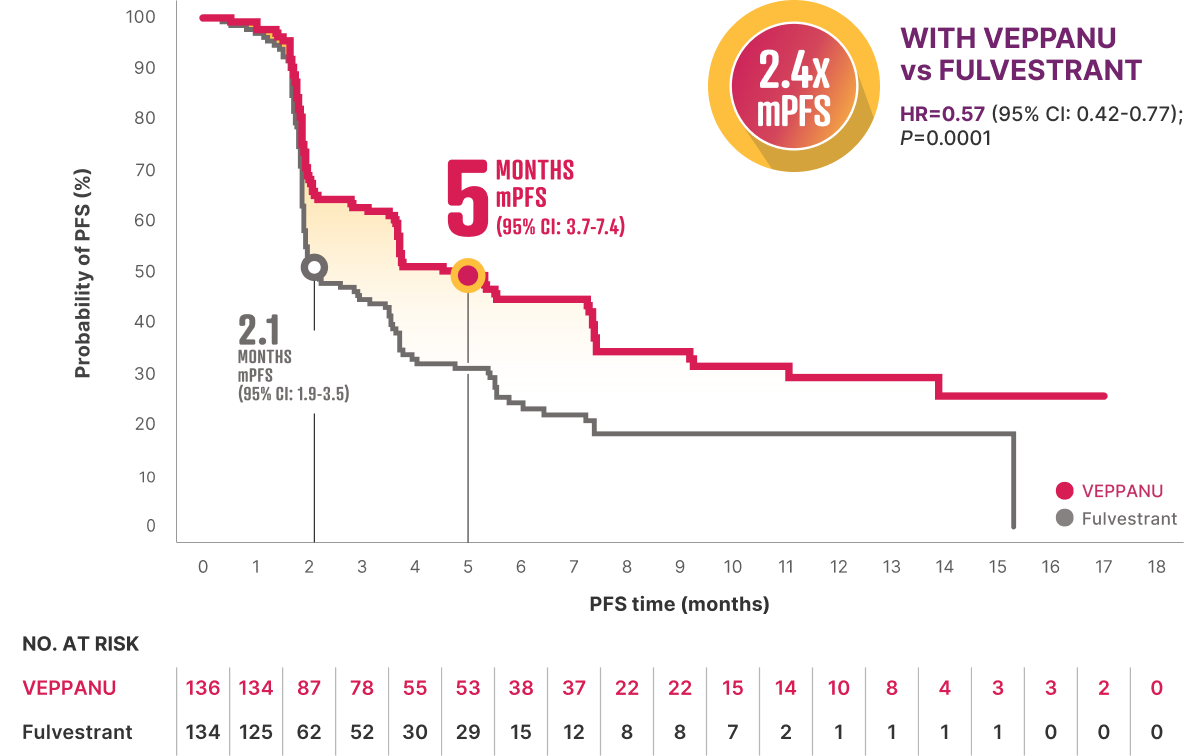
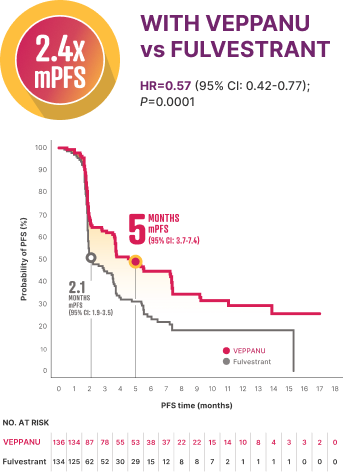
Graph with primary endpoint data, progression-free survival, for VEPPANU™ (vepdegestrant) Graph with primary endpoint data, progression-free survival, for VEPPANU™ (vepdegestrant)

*Results assessed by BICR. Median follow-up: 7.4 months with VEPPANU and 6.0 months with fulvestrant.1,2


mPFS Graphic Caption

2.4x mPFS with VEPPANU vs fulvestrant1

5 months vs 2.1 months with VEPPANU vs fulvestrant1

HR=0.57 (95% CI: 0.42-0.77); P=0.00011

VEPPANU reduced the risk of progression
or death by 43% vs fulvestrant (HR=0.57)1

ORR and CBR With VEPPANU and Fulvestrant

SELECT SECONDARY ENDPOINTS IN PATIENTS WITH ESR1m
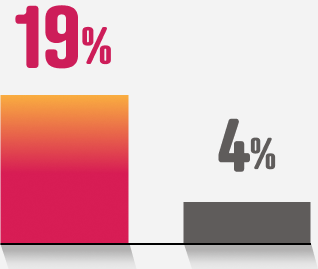
Objective response rate (ORR)1†‡
Objective response rate data (ORR, secondary endpoint) data for VEPPANU™ (vepdegestrant)

VEPPANU
(95% CI: 12-27)

Fulvestrant
(95% CI: 1.6-10)
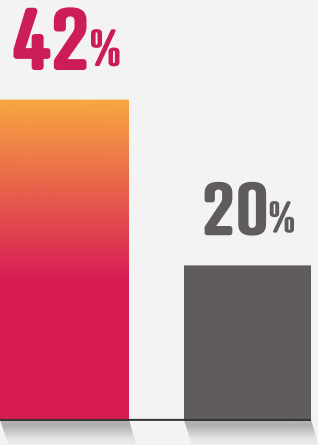
Clinical benefit rate (CBR)3†§
Clinical benefit rate data (CBR, secondary endpoint) data for VEPPANU™ (vepdegestrant)

VEPPANU
(95% CI: 33.7-51.1)

Fulvestrant
(95% CI: 13.9-28.3)

ORR and CBR Graphic Caption

Objective response rate: 19% with VEPPANU and 4% with fulvestrant

Clinical benefit rate: 42% with VEPPANU and 20% with fulvestrant

Overall survival was immature at the time of PFS analysis.1

†Results were assessed by BICR using RECIST v1.1.1

‡ORR was defined as the proportion of confirmed complete response or partial response among patients with measurable disease at baseline.3

§CBR was defined as the proportion of patients who had confirmed complete response or partial response at any time, or stable disease, noncomplete response, or nonprogressive disease for ≥24 weeks (for patients enrolled for ≥24 weeks prior to data cutoff or those with confirmed CR or PR).3

PFS Results Across Patient Subgroups2

Data from prespecified subgroup analyses of PFS in patients with ESR1m disease are presented for observational purposes only. Small patient numbers can be a limitation of subgroup analyses, and the confidence intervals were not adjusted for multiplicity and cannot be used to infer treatment effects.
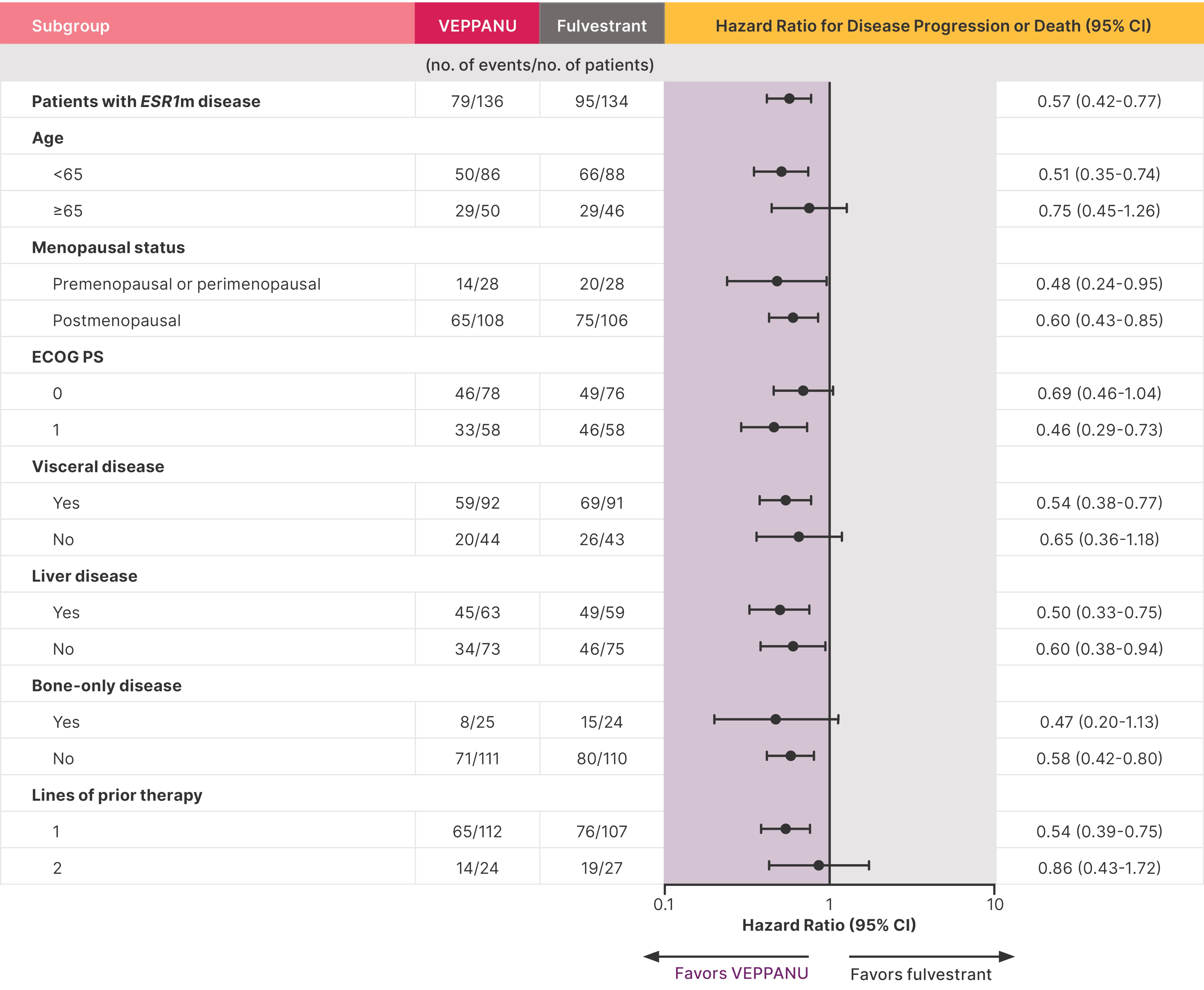
PFS RESULTS IN SUBGROUP ANALYSES IN PATIENTS WITH ESR1m, ER+/HER2– mBC AFTER CDK4/6i AND ≥1 PRIOR ET
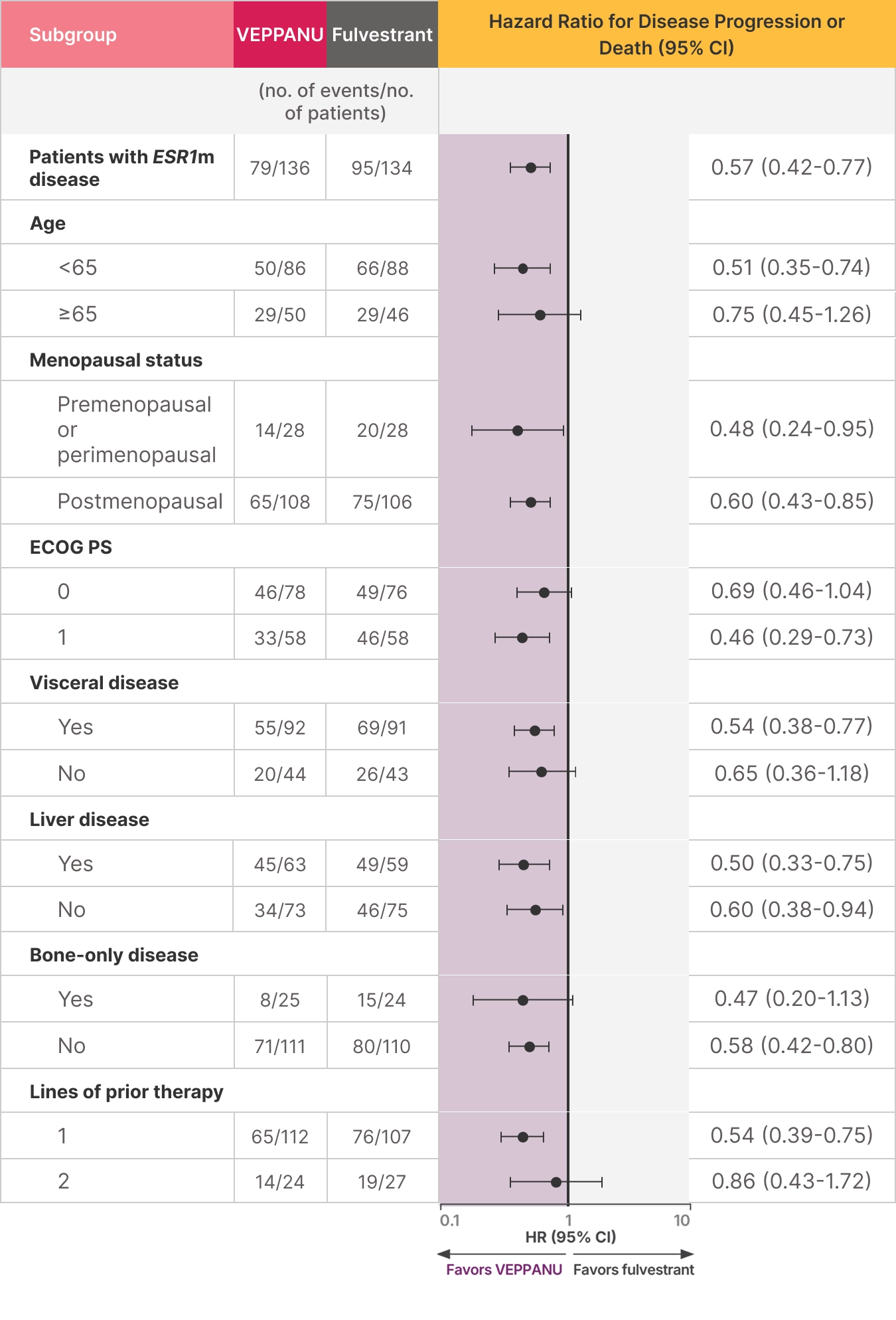
PFS results across patient subgroups: VEPPANU versus fulvestrant, events/patients and hazard ratios with 95% confidence intervals.
Patient subgroups: ESR1m disease, age, menopausal status, ECOG PS, visceral, liver and bone-only disease, and lines of prior therapy.

This subgroup analysis of PFS was assessed by BICR.2

PFS Results in Subgroup Analyses Caption

Patients with ESR1m disease:

Events: VEPPANU, 79/136, Fulvestrant, 95/134. HR: 0.57 (95% CI: 0.42-0.77)

Age:

<65: Events: VEPPANU, 50/86, Fulvestrant, 66/88. HR: 0.51 (95% CI: 0.35-0.74)
≥65: Events: VEPPANU, 29/50, Fulvestrant, 29/46. HR: 0.75 (95% CI: 0.45-1.26)

Menopausal status:

Premenopausal or perimenopausal: Events: VEPPANU, 14/28, Fulvestrant, 20/28. HR: 0.48
(95% CI: 0.24-0.95)
Postmenopausal: Events: VEPPANU, 65/108, Fulvestrant, 75/106. HR: 0.60 (95% CI:
0.43-0.85)

ECOG PS

0: Events: VEPPANU, 46/78, Fulvestrant, 49/76. HR: 0.69 (95% CI: 0.46-1.04)
1: Events: VEPPANU, 33/58, Fulvestrant, 46/58. HR: 0.46 (95% CI: 0.29-0.73)

Visceral disease:

Yes: Events: VEPPANU, 59/92, Fulvestrant, 69/91. HR: 0.54 (95% CI: 0.38-0.77)
No: Events: VEPPANU, 20/44, Fulvestrant, 26/43. HR: 0.65 (95% CI: 0.36-1.18)

Liver disease:

Yes: Events: VEPPANU, 45/63, Fulvestrant, 49/59. HR: 0.50 (95% CI: 0.33-0.75)
No: Events: VEPPANU, 34/73, Fulvestrant, 46/75. HR: 0.60 (95% CI: 0.38-0.94)

Bone-only disease:

Yes: Events: VEPPANU, 8/25, Fulvestrant, 15/24. HR: 0.47 (95% CI: 0.20-1.13)
No: Events: VEPPANU, 71/111, Fulvestrant, 80/110. HR: 0.58 (95% CI: 0.42-0.80)

Lines of prior therapy:

1: Events: VEPPANU, 65/112, Fulvestrant, 76/107. HR: 0.54 (95% CI: 0.39-0.75)
2: Events: VEPPANU, 14/24, Fulvestrant, 19/27. HR: 0.86 (95% CI: 0.43-1.72)

Study Design: VEPPANU Was Evaluated for Efficacy and Safety in Patients With ESR1m, ER+/HER2– mBC

VERITAC-2: A global,
open-label, phase 3 trial1,2,7**††

Adults with advanced
or metastatic ESR1m,
ER+/HER2− breast cancer

1:1 Randomization (N=270)

VEPPANU

n=136

200 mg oral
once daily, continuously,
until
disease progression or unacceptable toxicity

Fulvestrant

n=134

500 mg IM
Cycle 1: day 1
and day 15
Cycle ≥2: day 1,
28-day cycle, until disease progression or unacceptable toxicity

Primary endpoint

PFS by RECIST v1.1
per BICR

Select secondary endpoints

OS, ORR, CBR, patient-reported outcomes, safety

**

Efficacy results presented are from the ESR1m mBC population only (n=270); the trial included patients with and without identified ESR1 mutations (N=624). ESR1m status was determined by blood circulating tumor deoxyribonucleic acid (ctDNA). The other primary endpoint, PFS in the overall population, did not reach statistical significance.2

††

Patients underwent randomization at 213 sites in 25 countries between March 3, 2023, and October 30, 2024. The data-cutoff date was January 31, 2025.2

Additional Study Information

Additional inclusion criteria7

•

Age ≥18 years (including patients in pre- or perimenopause)

•

Prior line of CDK4/6i + ET

•

≤1 additional ET

•

Most recent ET ≥6 months prior to disease progression

•

Measurable disease evaluable per RECIST v1.1 or nonmeasurable bone-only disease

•

ECOG PS 0-1

Exclusion criteria7

Advanced, symptomatic visceral spread with a risk of life-threatening complications in the short term; prior treatment with VEPPANU, fulvestrant, elacestrant, mTOR/PI3K/AKT pathway inhibitors, PARP inhibitor, or other investigational agents (including novel ET, any SERDs, SERCAs, or CERANs) for any setting; prior chemotherapy for advanced/metastatic disease; inadequate liver, kidney, and bone marrow function; active brain metastases; significant concomitant illness.

All patients in VERITAC-2 had prior CDK4/6i + ET, and the majority had visceral disease and bone metastases2

Baseline characteristics were generally similar between treatment groups

VERITAC-2 included patients with a broad range of clinical characteristics2

SELECT PATIENT CHARACTERISTICS

Characteristic Patients With ESR1 Mutations
Characteristic VEPPANU
(n=136)
Fulvestrant
(n=134)
Age, median (range) 60 (26-87) 60 (34-85)
Female99%100%
Postmenopausal‡‡79%79%
Race/Ethnicity§§
White43%52%
Asian45%37%
Black3%4%
Unknown/not reported9%8%
ECOG PS
057%57%
143%43%
PIK3CA/AKT1/PTEN alterations643%41%
Visceral disease¶¶68%68%
Sites of disease ##
Bone85%84%
Liver46%44%
Lymph node38%35%
Breast32%34%
Lung27%28%
Measurable disease||||71%75%
Bone-only disease***18%18%
Previous lines of therapy for advanced or metastatic disease
182%80%
218%20%
Previous ET for advanced or metastatic disease100%100%
Previous CDK4/6i100%100%

‡‡Three men (2 in the VEPPANU group and 1 in the fulvestrant group) were assigned a status of “premenopausal or perimenopausal.”2

§§Race/ethnicity was reported by the patients.2

¶¶Visceral disease was defined as the presence of a tumor or lesion in the brain, liver, lung, peritoneum, pleura, or pleural cavity, according to investigator assessment.2

##Metastatic sites were determined by the investigator.2

||||Measurable disease was assessed by BICR with RECIST v1.1, with eligibility based on investigator assessments.2

***Bone-only disease was determined by BICR, with eligibility based on investigator assessments.2

AKT=protein kinase B; AKT1=AKT serine/threonine kinase 1; BICR=blinded independent central review; CBR=clinical benefit rate; CDK4/6i=cyclin-dependent kinase 4 and 6 inhibitor; CERANs=complete estrogen receptor antagonists; CI=confidence interval; CR=complete response; ECOG PS=Eastern Cooperative Oncology Group performance status; ER+/HER2–=estrogen receptor–positive/human epidermal growth factor receptor 2–negative; ESR1=estrogen receptor 1; ESR1m=estrogen receptor 1 mutation; ET=endocrine therapy; HR=hazard ratio; mBC=metastatic breast cancer; mPFS=median progression-free survival; mTOR=mammalian target of rapamycin; ORR=objective response rate; OS=overall survival; PARP=poly ADP ribose polymerase; PFS=progression-free survival; PI3K=phosphoinositide 3-kinase; PIK3CA=phosphatidylinositol-4,5-bisphosphate 3-kinase catalytic subunit alpha; PR=partial response; PTEN=phosphatase and tensin homolog; RECIST v1.1=Response Evaluation Criteria in Solid Tumors version 1.1; SERCAs=selective estrogen-receptor covalent antagonists; SERDs=selective estrogen-receptor degraders.

REFERENCES

1. VEPPANU [package insert] South San Francisco, CA: Rigel Pharmaceuticals, Inc. 2. Campone M, De Laurentiis M, Jhaveri K, et al. Vepdegestrant, a PROTAC estrogen receptor degrader, in advanced breast cancer. N Engl J Med. 2025;393(6):556-568. doi:10.1056/NEJMoa2505725 3. Campone M, De Laurentiis M, Jhaveri K, et al. Vepdegestrant, a PROTAC estrogen receptor degrader, in advanced breast cancer (supplement). N Engl J Med. 2025; doi:10.1056/NEJMoa2505725 4. Rogge AA, Liegl G, Snyder C, et al. EORTC QLQ-C30 general population normative data for the United States. Eur J Cancer. 2024;202:114030. doi: 10.1016/j.ejca.2024.114030 5. Questionnaires. EORTC Quality of Life. January 14, 2026. Accessed September 22, 2026. https://qol.eortc.org/questionnaires/ 6. Data on file, Rigel Pharmaceuticals, Inc. September 2026. 7. Campone M, De Laurentiis M, Jhaveri K, et al. Vepdegestrant, a PROTAC estrogen receptor degrader, in advanced breast cancer (protocol). N Engl J Med. 2025;393(6):556-568. doi:10.1056/NEJMoa2505725

VEP_BC-26097 1026